
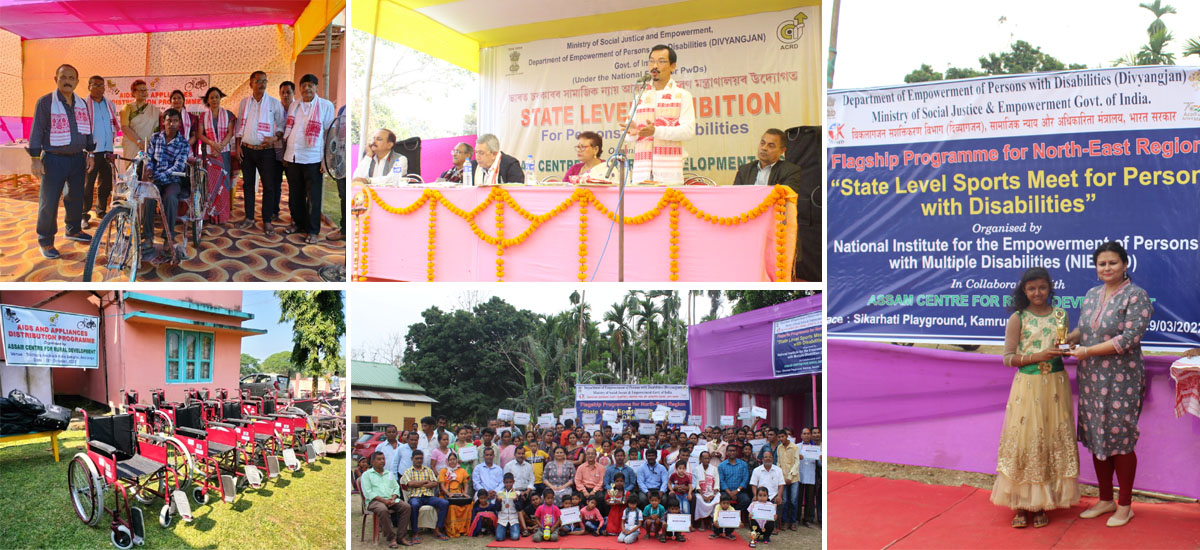
Disability
Community Based Rehabilitation Programme (CBR)
In an effort to improve the living conditions of persons with disabilities (PwDs), ACRD launched the Community-Based Rehabilitation for Persons with Disabilities (CBR) programme in 2008 in Chandrapur Block, Kamrup metro district. This programme focuses on enhancing the health, education, and livelihood of PwDs, along with their socio-economic empowerment. The overarching goal of the project is to facilitate the integration and participation of PwDs in society.
From 2015 to 2020, the CBR programme extended its reach to PwDs in four Gram Panchayats (Rani, Uttar Bholagaon, Dakshin Bholagaon, and Kahikuchi) of Rani Block, Kamrup district. This was achieved through home-based rehabilitation services, ensuring the convergence of government schemes for PwDs and CwDs, conducting awareness meetings, and forming Disabled Persons’ Organisations (DPOs) at the village level. These DPOs advocate for the rights and entitlements of PwDs at the Panchayat, Block, and District levels.
Project Impact:
In 30 villages of Rani Block, ACRD identified 417 persons with disabilities. As a result, 28 village-level Disabled People’s Organisations (DPOs), 4 Panchayat-level DPOs, and one block-level DPO were formed. These DPOs address various issues such as disability pensions, job cards under the Mahatma Gandhi National Rural Employment Guarantee Act (MGNREGA), disability certificates, and aids and appliances. Our programme team facilitated their approach to government offices and departments for obtaining aids and appliances, enrolling disabled children in schools and Anganwadi centres, engaging in income-generating activities, participating actively in social functions, and availing adequate government entitlements.
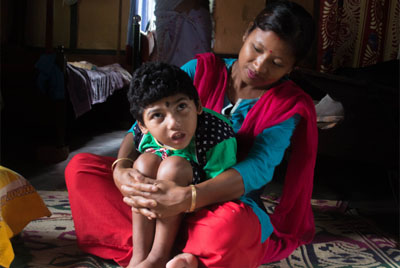 A CBR field worker giving home-based support to a Child with Disability (CWD)

Tapashi’s story:
Five-year-old Tapashi Talukdar suffers from profound mental retardation and initially lacked the skills necessary for daily living. Her parents, from a humble background, were devastated upon learning of her condition at birth, believing she would never lead a normal life. However, their perspective changed when our community-based rehabilitation (CBR) workers identified Tapashi through the CBR Programme. With regular home-based support from our CBR workers, physiotherapy for Tapashi, and counseling for her parents, her condition gradually improved. Now, Tapashi can sit on her own, bringing new hope to her family.
State level federation of persons with disabilities (SELF)
A State Level Disabled People’s Organization (SDPO) was formed in 2014 to address issues related to disabled people and raise them with government machinery to effect change at the policy level. DPO leaders were identified from five partner NGOs of the Community-Based Rehabilitation (CBR) programme in Assam.
The DPO leaders meet regularly to discuss various issues and hold interface meetings with key government officials from departments such as Social Welfare, Education, Health, and Rural and Urban Development. These meetings aim to advocate for better laws and the implementation of welfare schemes for the disabled.
A total of 1,928 people with disabilities have been inducted into the SDPO.
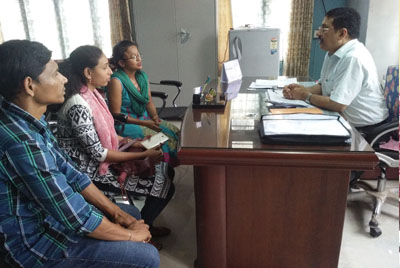 Key SDPO leaders meet Disability Commissioner, P.R. Gharphalia to submit a memorandum seeking addressal of issues of disabled people in the state
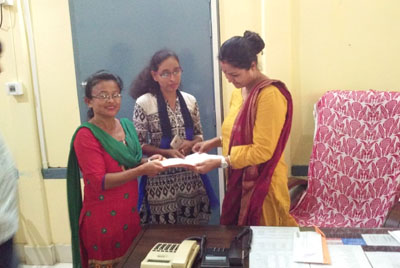 Key SDPO leaders meet Krishna Das, Chairperson, Assam State Social Welfare Board
Fellowship programme for persons with disabilities covering 4 GPs under Rani Development Block, Kamrup rural district of district of Assam.
In November 2018, ACRD began implementing the Fellowship Programme for Persons with Disabilities in four Gram Panchayats—Mazirgaon, Garal, Azara, and Dharapur—under Rani Development Block in Kamrup district. This project aimed to improve the lives of people with disabilities (PwDs) in a semi-urban area predominantly engaged in agriculture. Despite being semi-urban, PwDs in this region faced significant discrimination and lacked access to opportunities and government schemes. To address these issues, ACRD identified four PwDs from each Panchayat to work as fellows, who would be trained to advocate for their rights and access various entitlements. The project, which covered a population of 44,254 as per the 2011 census, focused on areas such as health, education, and livelihood, aiming to build networks with government departments and NGOs. By the project's end, expected outcomes included improved health and education access for PwDs, involvement in livelihood programs, and strengthened advocacy and collaboration efforts.